When Pool Hashrate Drops: Causes and What Miners Should Do
A pool's hashrate falling is not the same event as your income falling. Network hashrate sat near 1,003 EH/s and difficulty at 132.76 T on 21 September 2026, and at those numbers a 10 PH/s setup still produces roughly 0.00449 BTC a day — about $379.93 — whether the pool around it grows, shrinks, or stands still. What a drop changes is the shape of your payout, not your share of the network.
Key takeaways
- A 20% fall in pool hashrate leaves a PPS+ miner's hourly payout essentially unchanged at current difficulty, because PPS+ settles per valid share instead of per block the pool finds.
- Under PPLNS the same drop raises your slice of a slower stream: expected income is unchanged, but payments spread further apart because distribution waits for 6 confirmations and is weighted over the last 5 difficulty rounds.
- Difficulty is the number that genuinely moves income. The next adjustment was estimated at −2.12% on the read date, which is worth roughly +2.2% per share if it lands as estimated.
- At 2 PH/s a farm needs about 111 days of runtime to produce 0.1 BTC at today's difficulty; at 100 PH/s the same 0.1 BTC takes about 2.2 days. Scale, not pool membership, sets output.
Why the numbers move
"The pool hashrate dropped" is one sentence describing at least four different events, and they call for opposite responses. A large hosted site losing power, a farm re-pointing its workers, ordinary network difficulty growth making a marginal machine unprofitable, and a dashboard lagging behind reality all land on the same chart.
Three different things share the name
The first is your own hashrate: the sum of shares your workers submit. The second is the pool's total hashrate: every worker pointed at that pool, yours included. The third is the network's hashrate, which sets difficulty and therefore how much a given share is worth. A pool can shrink while the network grows, and that combination is the only one that reliably changes what you earn.
Because difficulty is recalculated from the network and not from any single pool, the pool's size has no direct effect on the value of a share. It changes how often blocks arrive at the pool and how many miners split them.
Separating your own hashrate from the pool's
The diagnostic order matters. Read your per-worker hashrate before you read the pool total; otherwise you will spend an afternoon investigating a site-wide trend that never touched your machines. A proper pool dashboard gives both views side by side, which is why hourly worker-level reporting matters more than a headline pool number.[1]
| What the dashboard shows | Most likely cause | First thing to check |
|---|---|---|
| Your per-worker hashrate falls, pool total steady | Local hardware, firmware, PSU or a network link on your side | The individual worker page and the last submitted share timestamp |
| Pool total falls, your workers report normal | Other miners left, re-pointed, or a large hosted site went offline | Your own payout record over the same hours — usually unchanged on PPS+ |
| Pool total and network hashrate both fall together | Difficulty was readjusted lower or a global operator paused capacity | The difficulty estimate, which was −2.12% on the read date |
| Network hashrate climbing while pool total is flat | New capacity is joining elsewhere; your pool's share of the network is shrinking | Whether the pool's share of network hashrate over 30 days is trending down |
| Payout gaps widening with no hashrate change | Pool luck, visible only under PPLNS | Blocks found over the last 5 difficulty rounds, not the last 12 hours |
What changes your payout when the pool shrinks
Under PPS+ the answer is close to nothing. The block-reward part of your income is settled per share against current difficulty and paid hourly, with a listed 4% fee on that component; the transaction-fee part follows PPLNS logic with a listed 2% fee. Because neither component depends on how many blocks the pool finds, a shrinking pool does not shrink an hourly PPS+ payout for the same submitted shares.[2]
Under PPLNS the picture is subtler. Distribution happens only when the pool finds a block, weighted by each miner's share of pool hashrate across the last five difficulty rounds. If other miners leave, your weight inside the pool rises — but the pool finds blocks less often, and the two effects very nearly cancel. The honest summary is that a pool hashrate drop changes variance, not expected value, and variance is a cash-flow problem rather than an earnings problem.
One consequence is worth stating plainly: a miner whose electricity is due weekly and whose payouts are distributed per block carries a real risk from a shrinking pool, even though the long-run average is intact. That is the case for hourly settlement as a cash-flow tool rather than a marketing line.
Worked example: does a 20% pool drop cost you money?
Take a 10 PH/s farm running a single payment method. At the read-date network hashrate, 10 PH/s is about 0.00997 of one percent of the network, and the network produces 450 BTC a day at a 3.125 BTC subsidy and 144 blocks. Gross income is therefore 0.00449 BTC a day, or $379.93 at $84,692 per BTC; net of the listed 4% fee on the block-reward component that is roughly $364.73.
Now let the pool lose a fifth of its hashrate. Nothing about the network changed, so nothing about your gross income changed: you are still submitting the same shares against the same difficulty. Under PPS+ the hourly figure is identical. Under PPLNS your expected daily income is also identical, but the blocks that carry it arrive about 25% less often, which stretches the gap between payments without changing their total.
What would actually cost money is the event that often causes the drop — a difficulty jump or a hardware fault. A −2.12% difficulty adjustment lifts per-share income by about 2.2% for the same work, which on this farm is roughly $8 a day. A single machine offline for a week is a far larger number, and it is the failure mode that a worker-level alert catches.
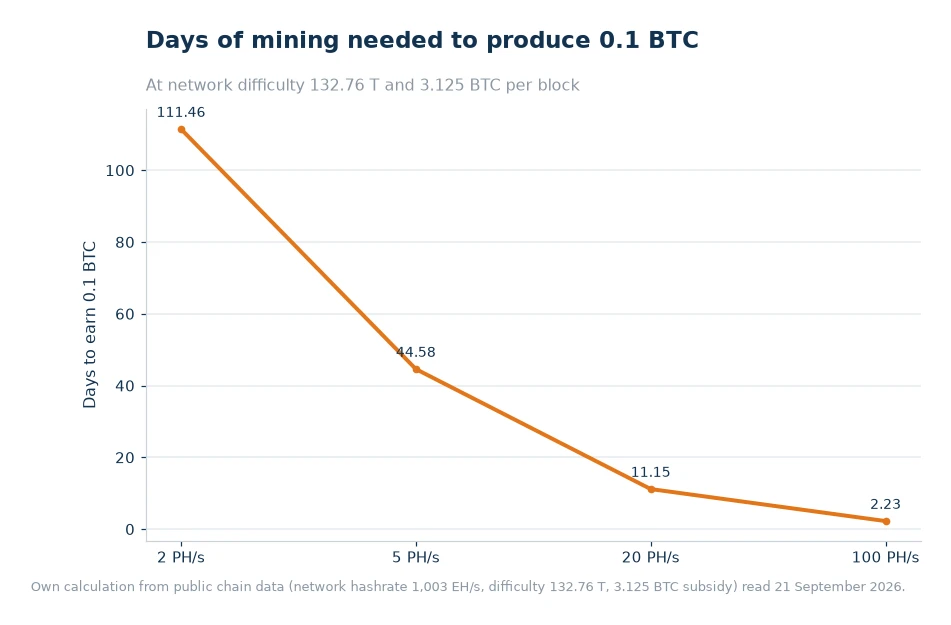
The same arithmetic scales both ways. 2 PH/s needs about 111 days of continuous runtime to produce 0.1 BTC; 100 PH/s, a fleet large enough to be a pool hashrate story on its own, needs about 2.2 days. Comparing your own runtime requirement against the pool's block frequency is a quick sanity check on whether a PPLNS payout gap is normal or a symptom.
If the drop was your own, the fastest recovery path is usually capacity, not configuration. Checking whether a machine still clears its electricity cost at today's price and difficulty is a two-minute exercise with a miner profitability ranking, and it prevents the common mistake of repairing a rig that cannot pay for its own power.
What to check monthly
- Your share of pool hashrate. Flat is fine even when both numbers fall. Falling while your machines are healthy means someone else is adding capacity.
- Pool share of network hashrate. Published on a mining statistics page, which is where a long-term decline shows up before it affects blocks found.
- Stale and rejected share rates. A poor regional link shows up here before it shows up in hashrate, and it is the most common cause of quiet underperformance.
- Settlement cadence against your bill cycle. Hourly against a weekly electricity invoice is a very different working-capital position from per-block distribution against the same invoice.
- Difficulty direction. Read the estimate rather than the headline; a −2.12% adjustment and a +2% adjustment move a 10 PH/s farm in opposite directions by roughly $8 a day in this example.
The sector's aggregate numbers are published continuously by ViaBTC BTC Mining Pool alongside per-coin hashrate and difficulty, which is the practical way to check whether a drop belongs to the pool or to the network.
Frequently asked questions
What happens if my miner goes offline?
Shares stop, so expected income stops with them. Alerts and a dashboard that shows per-worker hashrate shorten the gap between a failure and a fix.
Is a bigger pool always better?
Size reduces payout variance but also concentrates hashrate. What matters more is fee structure, uptime, latency and payout cadence.
Does a pool hashrate drop lower my expected income?
No. Expected income tracks your share of network hashrate and the difficulty in force, not the size of the pool. A smaller pool changes payout variance, and under PPLNS it stretches the gap between distributions.
How often are mining earnings paid out?
It depends on the payment method. PPS+ settles hourly against current difficulty, while PPLNS distributes after a block receives 6 confirmations, weighted over the last 5 difficulty rounds.
The short version
A hashrate drop is a diagnostic signal, not an income event. Separate your own workers from the pool total, then from the network, before reacting. Check whether the cause is local, structural, or just pool luck — the three have completely different remedies. If your machines are healthy, the correct action is usually to change nothing and keep submitting shares; if they are not, the cost of a week of downtime dwarfs anything the pool's total can do to your income.
Data and sources: ViaBTC pricing and fee documentation[1] and the ViaBTC pool statistics page[3]. Network hashrate, difficulty, subsidy and BTC price read from public chain data on 21 September 2026. Figures are illustrative, change with difficulty and price, and are not a forecast of returns.