Vetting a Custom Fragrance Manufacturer: A Step-by-Step Process
Evaluating a custom fragrance manufacturer is a sequence, not a feeling, and the order matters: brief first, capability second, sample third, process fourth, terms last. Buyers who reverse that order — falling in love with a sample before checking whether the supplier can repeat it — are the ones who discover problems after the money has moved. The seven steps below are arranged so that each one either produces evidence or ends the conversation cheaply.
Key takeaways
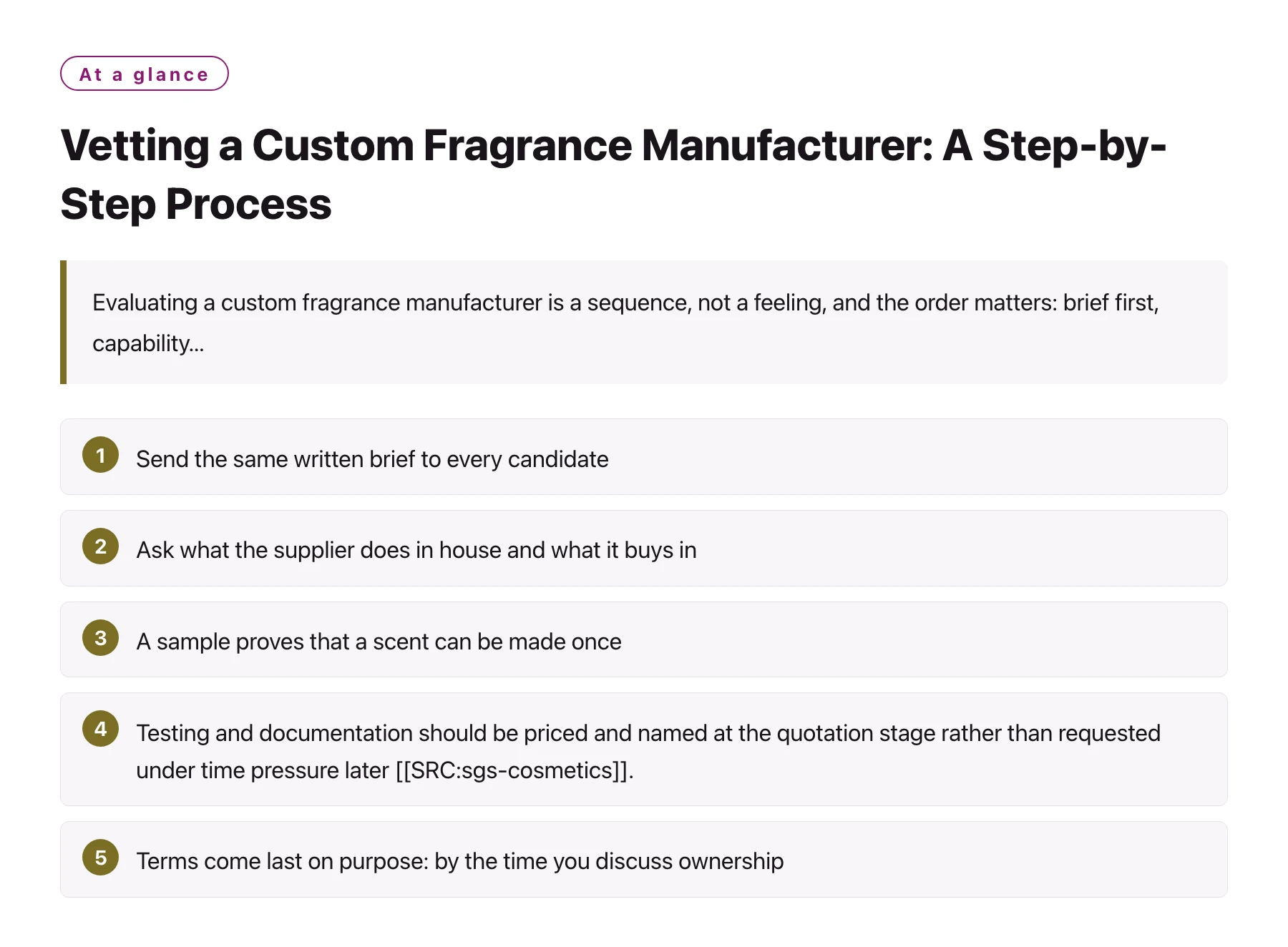
- Send the same written brief to every candidate; a supplier's questions about the brief tell you more than its answers about capability.
- Ask what the supplier does in house and what it buys in, because the boundary determines lead time, cost and who is accountable when something goes wrong.
- A sample proves that a scent can be made once; only a batch record proves that it can be made the same way twice.
- Testing and documentation should be priced and named at the quotation stage rather than requested under time pressure later [1].
- Terms come last on purpose: by the time you discuss ownership, exclusivity and tooling, you already know whether the supplier is worth negotiating with.
Most supplier evaluations collapse into a single question — does the sample smell right? That is necessary but it is nowhere near sufficient. The expensive failures in fragrance projects are rarely about the scent; they are about repetition, documentation and communication, all of which can be checked before a purchase order exists.
The process below assumes a brand with a defined product idea and a budget, not a finished formula. It takes longer to run than a round of emails, and it is far shorter than recovering from a supplier that cannot scale.
A seven-step evaluation, run in order
- Write the brief before you make contactProduct category, target price point, fill volume, concentration, pack direction, quantity, target market and launch date. A written brief makes every later comparison possible and filters out suppliers who only respond well to a phone call.
- Ask for the scope in writingWhich steps — development, compounding, filling, decoration, assembly, testing — happen on site, and which are subcontracted. Vague answers here predict vague answers everywhere else.
- Request two references that match your categoryNot the biggest projects, the most similar ones. A supplier that can describe the constraints of a category close to yours is more useful than one that lists an impressive but unrelated portfolio.
- Commission a sample against a defined briefAsk for a number of directions matched to your budget, and specify how the sample will be evaluated: on blotter, on skin, and against a reference you both hold.
- Walk through one batch recordFrom raw material intake to release. You are checking that the document exists, that it is legible, and that someone's name is against each step.
- Confirm the test and documentation planCompatibility, stability, and analytical verification of the batch, plus whatever your market requires. Get the list in writing with the testing party named.
- Negotiate the terms lastOwnership, exclusivity, tooling, approval reference, change costs and termination. None of these are worth discussing until the first six steps have produced evidence.
Why the order matters more than the checklist
Steps one to three cost almost nothing and eliminate most of the risk. Steps four to six cost money and time, and should only be spent on suppliers that survived the first three. The final step is where leverage sits, and it is strongest when there is still an alternative candidate in the running.
The trap for first-time buyers is the sample. A good sample is persuasive, and it is deliberately so — it is the supplier's best work. Treating sample approval as the end of evaluation rather than the middle of it is how brands end up committed to a supplier whose process has never been examined.
This is also why the evaluation produces a document set at every stage. A supplier that answers the first three steps in writing is not necessarily better than one that answers on a call, but the written answers make the rest of the comparison possible — and they are the ones you can re-read when something goes wrong.
The scope question is the one that changes quotes
A large plant, a development studio and a trading intermediary can all present themselves as a contract manufacturer for perfume brands, and all three can be legitimate choices. What differs is where the work happens. When decoration or filling is subcontracted, the buyer inherits an extra handover, an extra lead time and an extra point at which responsibility can be disputed. Ask for the boundary explicitly and write it into the quotation.
Evidence beats assurance at every step
You will hear that a factory is experienced, that its quality system is strong, and that documentation is no problem. None of that is checkable. What is checkable: a certificate with a number, a batch record with a signature, a test report with a laboratory named on it, and a sample retained by both parties with a date on the label.
The point of the check is not to catch anyone out. It is that a supply relationship depends on being able to answer questions months later, when the person who handled the original order has moved to another role.
That is also why the sharper list is not the one you prepare but the one the supplier comes back with: the questions to ask a perfume factory are, in practice, a preview of how the project will be run.
Keep a one-page evaluation file per candidate: brief sent, scope answer, reference calls, sample dates, batch record seen or not, testing plan, terms. Two pages of notes will settle arguments that memory cannot, and the file gets reused when the product is reformulated or a second supplier is added.
The checks that take the longest — and are worth it
Two steps consume most of the calendar time. The first is sampling: development, revision and approval routinely take several rounds, and rushing it just moves the discovery into the bulk order. The second is testing, which cannot be compressed by pressure — a stability study measures change over time, and time is the measurement.
Testing is also the step where buyers cut corners most often, usually because it appears as a cost with no visible product attached. Third-party laboratories publish the scope of cosmetic and personal care testing they provide, which is a helpful way to see what a complete set covers before deciding which parts to request [1]. When a buyer specifies the test plan early, suppliers can price it properly; when it is requested late, it becomes a rush charge and a launch delay.
The remaining risk is human. Process quality depends on how well a supplier's team can absorb a brief it did not write, and the questions a supplier asks during an evaluation are really a test of that absorption. A supplier that asks precise, uncomfortable questions early — about your fill tolerance, your carton, your market's labelling — is telling you how it will behave when the project is in production.
Finally, decide in advance what would make you walk away: no batch records, no named testing partner, no willingness to state the scope, no answer on ownership. Written down before the evaluation starts, those conditions keep the decision honest, because by the time the samples are on the table, everything looks promising. It also makes the final step — the terms — a genuinely what to verify before signing with a fragrance manufacturer rather than a formality.
Sources
- SGS: Cosmetics, Personal Care & Household Testing —— Testing, inspection and certification services for cosmetics and personal care, including microbiological, stability and safety testing aligned with cosmetics GMP.
Frequently asked questions
How long should the evaluation of a fragrance manufacturer take?
Four to eight weeks is a realistic range for a brand with a defined brief, most of it spent on sampling and testing rather than on paperwork. Shortening it is possible but usually means accepting a higher chance of a problem appearing in the first bulk order.
What is the single most useful document to request?
A batch record from a comparable production run, walked through with the person who completed it. It reveals the real process, including any gaps between what the quality manual describes and what happens on the floor.
Should I visit the factory before ordering?
A visit is useful but not decisive, and it favours suppliers with impressive reception areas. If you can only do one thing, request the documents and the sample record; if you can do both, use the visit to verify what the documents claimed.
How many sample rounds should I expect?
Two to four is normal for a new fragrance, more if the brief was broad or the target is a specific reference. Each round should narrow the direction rather than restart it, and the brief should be updated in writing as the target shifts.
What if the supplier refuses to share its client list?
That is a normal and reasonable position, particularly under confidentiality agreements. Ask instead for a description of comparable projects, and offer to speak with clients under an NDA rather than pressing for a public list.