How Do Period Panties Prevent Menstrual Leaks?
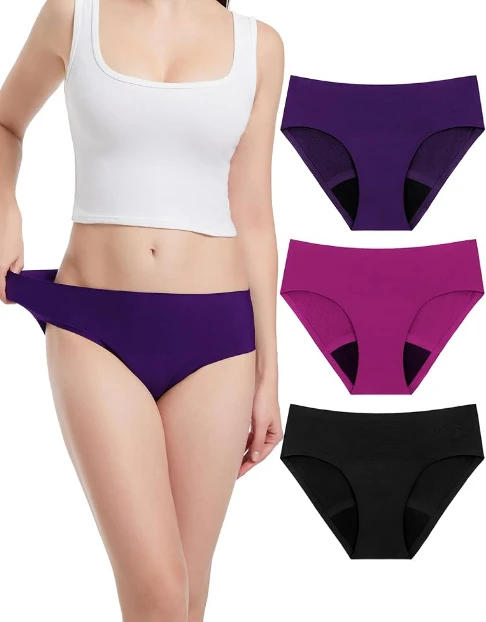
Period panties prevent leaks by managing menstrual fluid in stages rather than relying on one thick absorbent fabric. A typical gusset combines a moisture-transfer surface, an absorbent middle, and a liquid-resistant backing. The surface moves fluid away from the skin, the middle stores and spreads it, and the backing limits transfer to clothing. For context, U.S. tampon absorbency categories range from 6 g or less for “light” to 15–18 g for “ultra,” while period underwear has no equivalent standardized U.S. absorbency scale. Leak control therefore depends on absorption rate, usable capacity, coverage, and fit together, not on fabric thickness alone.
Menstrual flow is not simply water. It contains blood, endometrial tissue, cervical mucus, and vaginal secretions, so its viscosity and flow pattern can vary during the same period. ACOG notes that menstrual blood loss has historically been reported at about 30 mL per cycle on average, while blood loss above 80 mL has been associated with heavy bleeding; current clinical definitions also consider how bleeding affects daily life. That variation explains why underwear that performs comfortably near the end of a period may reach its capacity much sooner on a heavier day.
The first contact point is normally the fabric facing the body. Rather than storing most of the fluid there, this layer is designed to let moisture move toward the material underneath. Small spaces between fibers support capillary movement, spreading liquid beyond the original contact point. Faster transfer matters when flow arrives within seconds instead of gradually over several minutes.
A dry-feeling surface does not necessarily mean the garment is dry. Fluid may already have moved into the absorbent layers underneath.
Once fluid passes through the surface, the middle structure provides storage. Depending on the manufacturer, it may contain cotton, viscose, polyester, microfiber, or blends arranged in several layers. Fiber diameter, fabric density, pore size, and total absorbent area affect how rapidly liquid enters and how much can remain in the textile when the wearer sits or moves.
That storage should not be confused with the standardized absorbency terminology used for tampons. Under U.S. federal rules, tampon categories correspond to measured ranges: light is 6 g or less, regular is more than 6–9 g, super is more than 9–12 g, super plus is more than 12–15 g, and ultra is more than 15–18 g. Manufacturers determine tampon absorbency using the specified Syngyna test.
No comparable federal scale makes a “heavy” pair of period underwear from one company automatically equivalent to a “heavy” pair from another. A brand may instead publish capacity in milliliters or compare a garment with a certain number of tampons. Those numbers are useful within a product line, but shoppers should not assume that two independently stated “4-tampon” products have undergone the same standardized test.
For that reason, the construction of period panties matters as much as a capacity number. If 10 mL enters one small section faster than the textile can distribute it, the local area may become wet while another part of the gusset remains relatively unused. Wider and longer absorbent zones give fluid more material through which to spread before reaching an edge.
Fluid distribution also explains why body position affects leakage. While standing, gravity tends to keep the contact area relatively predictable. During sleep, fluid can move farther toward the front or rear as the body changes position. An overnight garment may therefore use an absorbent panel extending substantially farther than the gusset found in ordinary underwear.
| Part of the garment | Main job | What can cause leakage |
|---|---|---|
| Body-facing layer | Transfers moisture downward | Transfer slower than incoming flow |
| Absorbent middle | Stores and spreads fluid | Local or total saturation |
| Liquid-resistant backing | Limits passage to clothing | Damage, wear, or incomplete coverage |
| Gusset shape | Keeps protection under the flow area | Fluid reaches an unprotected edge |
| Leg and waist fit | Holds the gusset in position | Gaps, shifting, or incorrect sizing |
After absorption and distribution comes containment. Many designs place a thin liquid-resistant membrane underneath the absorbent textile. Its purpose is different from that of the absorbent layer: the middle takes up liquid, while the lower layer reduces passage into jeans, pajamas, bedding, or other clothing. The two jobs need to occur together because storage without a backing can still allow moisture transfer under pressure.
Pressure becomes more relevant as saturation rises. Sitting places the wet textile between the body and a chair, while walking repeatedly compresses and releases parts of the gusset. A material may hold liquid when lying flat but behave differently when compressed. In practical use, retention under pressure matters alongside the maximum quantity a fabric can absorb in an unrestricted test.
Fit then determines whether the engineered layers remain beneath the area where fluid actually lands. A correctly sized pair should stay close to the body without creating painful pressure. Loose leg openings can create a route around the absorbent panel, while a gusset that shifts several centimeters during movement may leave ordinary fabric exposed to menstrual flow.
The same issue appears when the garment is too tight. Stretching can alter how a multilayer gusset sits against the body and may create uncomfortable pressure around seams or leg openings. Sizing should therefore follow the manufacturer's waist and hip measurements rather than assuming that a smaller size provides better leak protection.
Flow rate adds another limit that capacity labels cannot fully describe. A garment may have enough remaining storage for several milliliters yet still experience temporary surface pooling when a larger amount arrives quickly. The absorbent structure needs time to move fluid vertically and laterally, so “maximum capacity” and “maximum intake rate” describe different aspects of performance.
Clinical guidance provides a useful reference for unusually high flow. ACOG considers soaking through one or more pads or tampons every hour for several consecutive hours a sign of heavy menstrual bleeding; bleeding lasting more than 7 days is another sign. About one third of women seek treatment for heavy menstrual bleeding at some point, according to ACOG. Under those conditions, changing underwear frequently is not simply a product-selection issue, and medical assessment may be appropriate.
In adolescents evaluated for heavy menstrual bleeding, bleeding disorders are identified in about 20%, rising to approximately 33% among adolescents hospitalized for heavy menstrual bleeding.
Wear time should consequently be based on flow and garment condition rather than a universal hour count. Someone with light spotting may use the same pair far longer than someone whose flow would normally require a pad change every 1–2 hours. A persistently wet feeling, moisture approaching the edge of the absorbent panel, or visible breakthrough indicates that changing is appropriate regardless of the advertised capacity.
A comparison with tampons shows why “equivalent to X tampons” deserves careful reading. FDA rules require production sampling for tampon labeling so that there is a 90% probability that at least 90% of individual tampon absorbencies within a brand and type fall inside the labeled range. Period underwear capacity statements do not use that federal tampon labeling framework, so a numerical equivalence should not automatically be treated as a standardized clinical measurement.
Thickness is also a poor shortcut for judging performance. Adding fabric can increase potential storage, but it can also leave fluid concentrated near the entry point if the structure distributes liquid slowly. A thinner multilayer gusset may perform better when its body-facing layer accepts fluid rapidly and the underlying textile spreads moisture over a larger usable area.
Washing gradually becomes part of the performance question because the garment is designed for repeated use. Detergent residue, fabric coatings, high drying temperatures, and physical wear may affect some textiles, elastic components, or laminated layers. Care instructions vary by construction, so the manufacturer's washing and drying directions should take priority over a single universal routine.
Repeated washing also makes visual inspection useful. Separation between layers, damaged seams, reduced elasticity, or a backing that has begun to deteriorate can change how the underwear fits and contains fluid. If a pair begins leaking noticeably earlier than it did during its first months of use, garment condition should be considered alongside changes in menstrual flow.
The choice of absorbency should follow the day rather than the entire period. Menstrual bleeding can change considerably between day 1 and day 5, and ACOG describes a typical menstrual period as lasting up to about 7–8 days depending on the clinical definition being used. A person may therefore use higher-capacity underwear during heavier days and lighter construction when flow falls.
For overnight use, coverage deserves as much attention as stated capacity. A long rear absorbent panel can reduce the distance fluid must travel before encountering protected fabric when someone sleeps on their back, while extended front coverage can help in other positions. Side sleepers may place more importance on secure leg openings because fluid can approach the lateral edge of the gusset.
For exercise, movement creates a different requirement. Running, cycling, gym training, or repeated bending can shift underwear that fits loosely, even when the absorbent textile itself has plenty of unused capacity. Stretch recovery, seam placement, and stable contact around the legs therefore contribute to practical leak protection during movement.
The multilayer design works because each material handles a separate part of the same fluid path: the upper textile receives menstrual flow, the absorbent section distributes and stores it, the lower membrane limits passage outward, and the garment keeps the protected area in position. A failure at any one stage can produce a leak before the theoretical absorbency has been fully used.
Capacity claims are therefore most useful when read together with gusset dimensions, intended flow level, fit, and use case. FDA tampon ranges offer a useful numerical reference—6 g or less through 15–18 g—but they should not be used as a universal testing standard for reusable underwear. Real-world performance depends on how quickly menstrual fluid arrives, where it lands, how efficiently the fabric spreads it, and how much usable absorbent material remains at that moment.